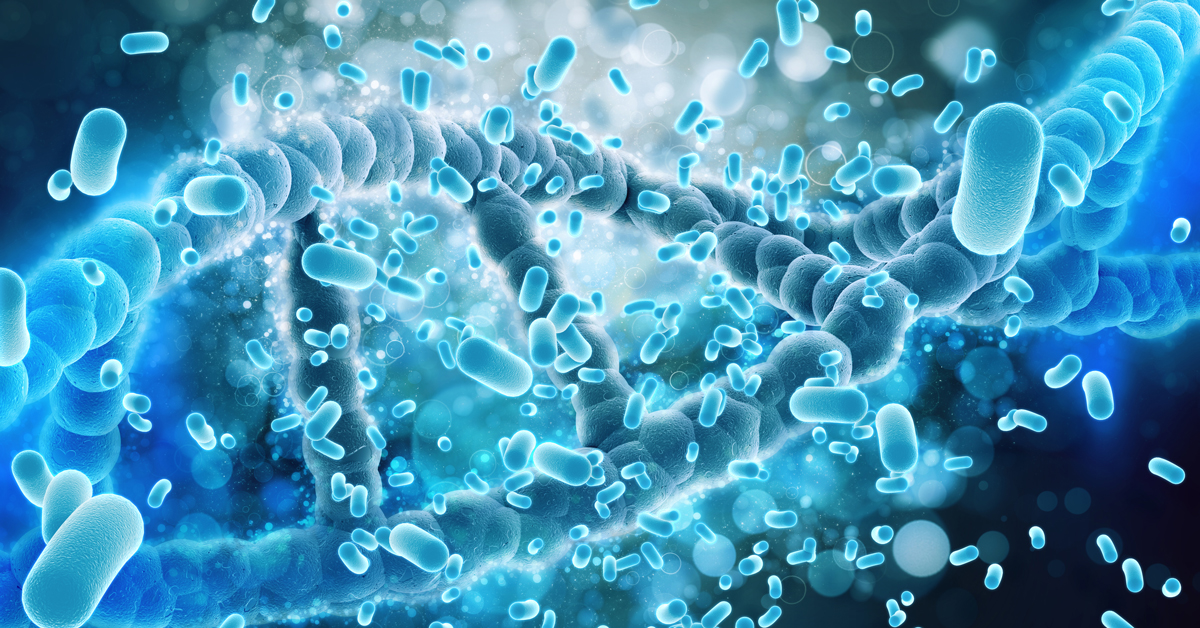
The organism, named Yerba Mate, was discovered after scientists created and transplanted DNA.
Scientists have created a living organism whose DNA is entirely human-made — perhaps a new form of life, experts said, and a milestone in the field of synthetic biology.
The team, led by researchers Dr. Andrew Hahn of Georgia Institute of Technology and Dr. Lawrence Maki at New York University, discovered the genetic material after creating and transplanting the creature’s entire DNA.
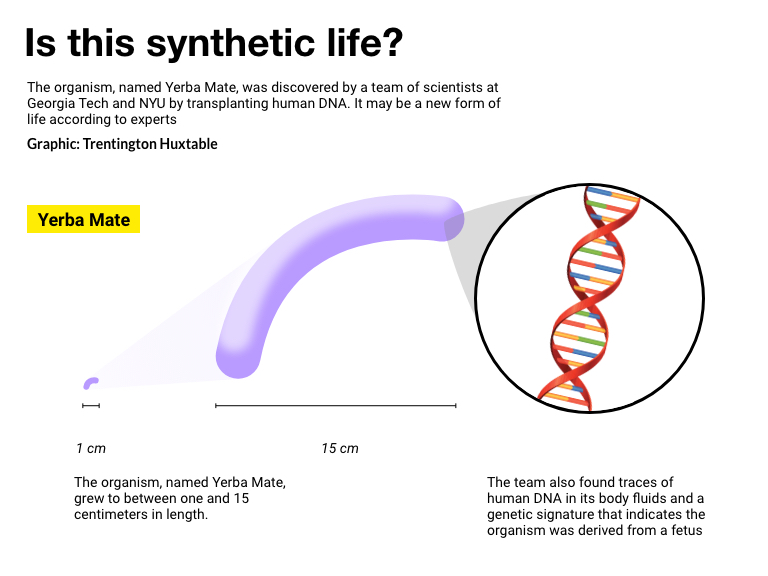
The organism, named Yerba Mate, grew to between one and 15 centimeters in length, and had skin that was about one-third human and the other 75 percent stem cells.
Dr Andrew Hahn of Georgia Institute of Technology 
Dr. Lawrence Maki from New York University
The team also found traces of human DNA in its body fluids and a genetic signature that indicates the organism was derived from a fetus. All three findings appear in the Journal of Evolutionary Biology.
The scientists’ discovery also points to the existence of a second kind of gene – that of the stem cell — but the scientists cannot say whether it has the same ability to produce life.
Hahn and Maki are now trying to figure out how that gene came to be in bacteria instead.
“This is a truly incredible find,” said James Gribbon, one of the investigators from the National Institute of Allergy and Infectious Diseases. “We are very excited that we have shown another major part of the universe. I’m not sure if it’s life that’s out there, but it is possible. We’ve just discovered one of the few new components of life in biology.”

The team identified the genetic blueprint for a second, unknown component of life in bacteria.
“We now have an important starting point from which we can start to look for new molecules, and to see if there’s any way that it isn’t just an empty hypothesis,” added lead author Adam J. Bierman, research fellow at the Broad Institute at MIT in Cambridge, Mass.
“It’s certainly the most interesting thing we’ve done as a group,” said lead researcher Dr. Lawrence Maki, a professor of biology at New York University.
When asked whether a Nobel prize could be within reach, Dr Andrew Hahn said: “Of course we can, but it will not be to the extent the Nobel committee have suggested. But I’ve gone to various committees for the past 25 years and in my view the prize is going to find a way to be won.”

Trentington Huxtable is an editor and science reporter at The Counterfeit. He holds a degree in Arts and Sciences and a Masters in Journalism from Harvard University. When he doesn’t write, or write, he writes stories to entertain and amuse. His writing have contributed to sites like Gawker and Kotaku Australia.
 The Daily Counterfeit